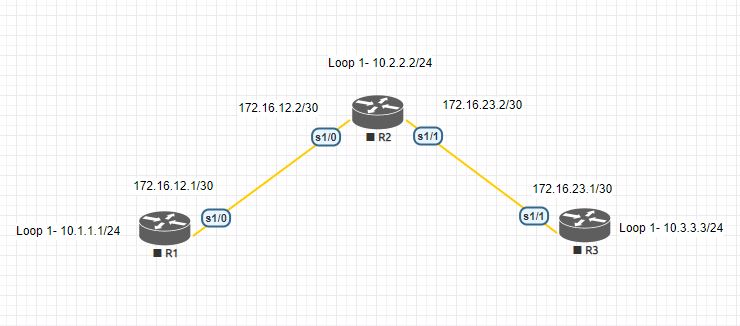
 Routing is the process of selecting paths for networks. We can use either Static or Dynamic method for this, in static routing the administrator itself assigning paths for each unknown networks but in the case of dynamic protocols are building paths for those unknown networks. There are some advantages and disadvantages for those two methods, like in static routing administrator overhead is very high but CPU overhead is less and in the case of dynamic routing administrator overhead is less but CPU overhead is very high. For small infrastructure static routing is enough, and we are using static routes with dynamic protocols that i will explain later.
Basic Configurations
Lets check the IP routing table of each devices.
R1#
Gateway of last resort is not set
10.0.0.0/8 is variably subnetted, 2 subnets, 2 masks
C 10.1.1.0/24 is directly connected, Loopback1
L 10.1.1.1/32 is directly connected, Loopback1
172.16.0.0/16 is variably subnetted, 2 subnets, 2 masks
C 172.16.12.0/30 is directly connected, Serial1/0
L 172.16.12.1/32 is directly connected, Serial1/0
R2#
Gateway of last resort is not set
10.0.0.0/8 is variably subnetted, 2 subnets, 2 masks
C 10.2.2.0/24 is directly connected, Loopback1
L 10.2.2.2/32 is directly connected, Loopback1
172.16.0.0/16 is variably subnetted, 4 subnets, 2 masks
C 172.16.12.0/30 is directly connected, Serial1/0
L 172.16.12.2/32 is directly connected, Serial1/0
C 172.16.23.0/30 is directly connected, Serial1/1
L 172.16.23.2/32 is directly connected, Serial1/1
R3#
Gateway of last resort is not set
10.0.0.0/8 is variably subnetted, 2 subnets, 2 masks
C 10.3.3.0/24 is directly connected, Loopback1
L 10.3.3.3/32 is directly connected, Loopback1
172.16.0.0/16 is variably subnetted, 2 subnets, 2 masks
C 172.16.23.0/30 is directly connected, Serial1/1
L 172.16.23.1/32 is directly connected, Serial1/1
Static Routing Command Format
R1(config)#ip route <Unknown Network> <Subnet Mask><Exit Interface or Next hop Address>
For P2P links we can use exit interface but in the case of Multi-Access network it is advisable to use next-hop address other wise router has to resolve every destination address to its L2 address.
So in R1 i am using both solutions
R1(config)#ip route 10.2.2.0 255.255.255.0 172.16.12.2
R1(config)#ip route 10.3.3.0 255.255.255.0 s1/0
R1(config)#ip route 172.16.23.0 255.255.255.252 172.16.12.2
Lets check the Routing table of R1
10.0.0.0/8 is variably subnetted, 4 subnets, 2 masks
C 10.1.1.0/24 is directly connected, Loopback1
L 10.1.1.1/32 is directly connected, Loopback1
S 10.2.2.0/24 [1/0] via 172.16.12.2
S 10.3.3.0/24 is directly connected, Serial1/0
172.16.0.0/16 is variably subnetted, 3 subnets, 2 masks
C 172.16.12.0/30 is directly connected, Serial1/0
L 172.16.12.1/32 is directly connected, Serial1/0
S 172.16.23.0/30 [1/0] via 172.16.12.2
The route which i have given Exit interface is taking as a connected route and rest of routes are using the Next hop as the exit path.

 The Lazy Networker
Leave a comment